




User archetypes

I advocated for UX Research resources to enable the company to better understand user behavior and enable funnel personalization.

🔍 UX research
👩🏻‍🏫 Team leadership
🧠 Design strategy
🗣️ Stakeholder management
User Archetypes
OBJECTIVE

Create archetypes for our life insurance product, to enable personalization

We had a one-size-fits-all life insurance product funnel. Without personalization, improvements were either (1) not leading to the scale of change expected, or (2) an improvement in one part of the funnel would hurt another part. But first, we needed to identify our users and their behaviors and motivations.

CONSTRAINTS

Get stakeholder buy-in for UX Research resources

My designers did not have capacity to run large-scale user research projects, but the CEO was not convinced that a UX Research headcount was warranted. I lobbied for freelance budget to prove out the importance of UX Research as a function. The CEO agreed to 3 months of budget as a test. One of the first projects we worked on was creating user archetypes for the life insurance product, as I theorized that the issues we were facing in our insurance funnel was due to a lack of funnel personalization.

Process

Discovery Icon

Discovery

User interviews

Synthesis Icon

Synthesis

Data aggregation and mapping to identify trends

Archetypes Icon

Archetypes

Identified 3 core archetypes and their pain points and motivations

Validation Icon

Validation

Tested archetypes in-funnel to see if they behaved the way we predicted

Implementation Icon

Implementation

Archetypes become the backbone of our product strategy

Process Visual
Discovery Icon

Discovery

User interviews

Users were recruited via an email sent to our existing Fabric list serve of life insurance customers, and via a website pop-up, offering a $25 Amazon gift card for a 20 minute interview. We used Calendly to set up the interviews, which were conducted via either Google Meet or phone call. We wanted to get input from both purchasers and non-purchasers, to get a complete picture of users visiting the product funnel.

We conducted a total of 10 user interviews.
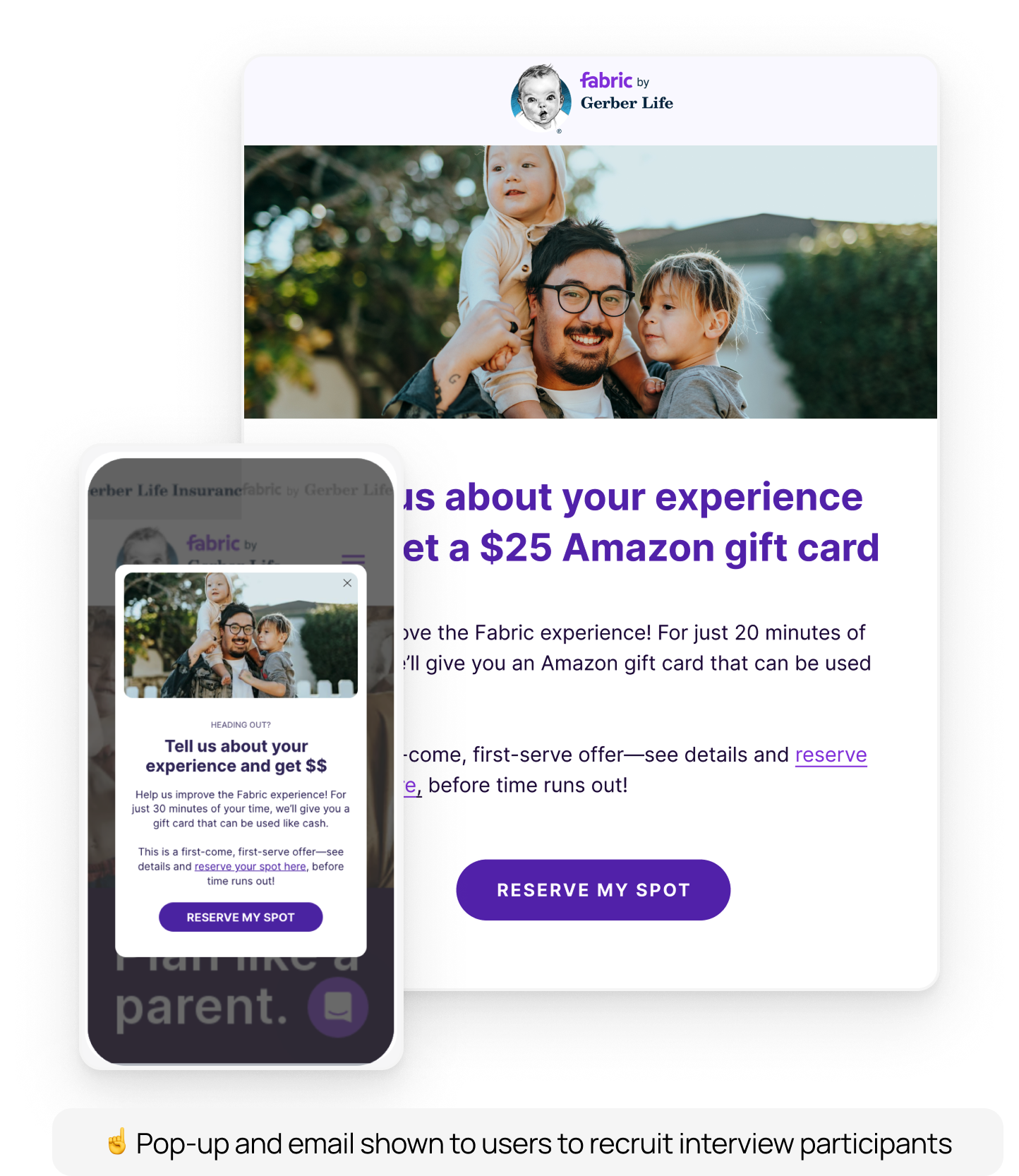
User interview recruitment email
Synthesis Icon

Synthesis

Affinity Mapping

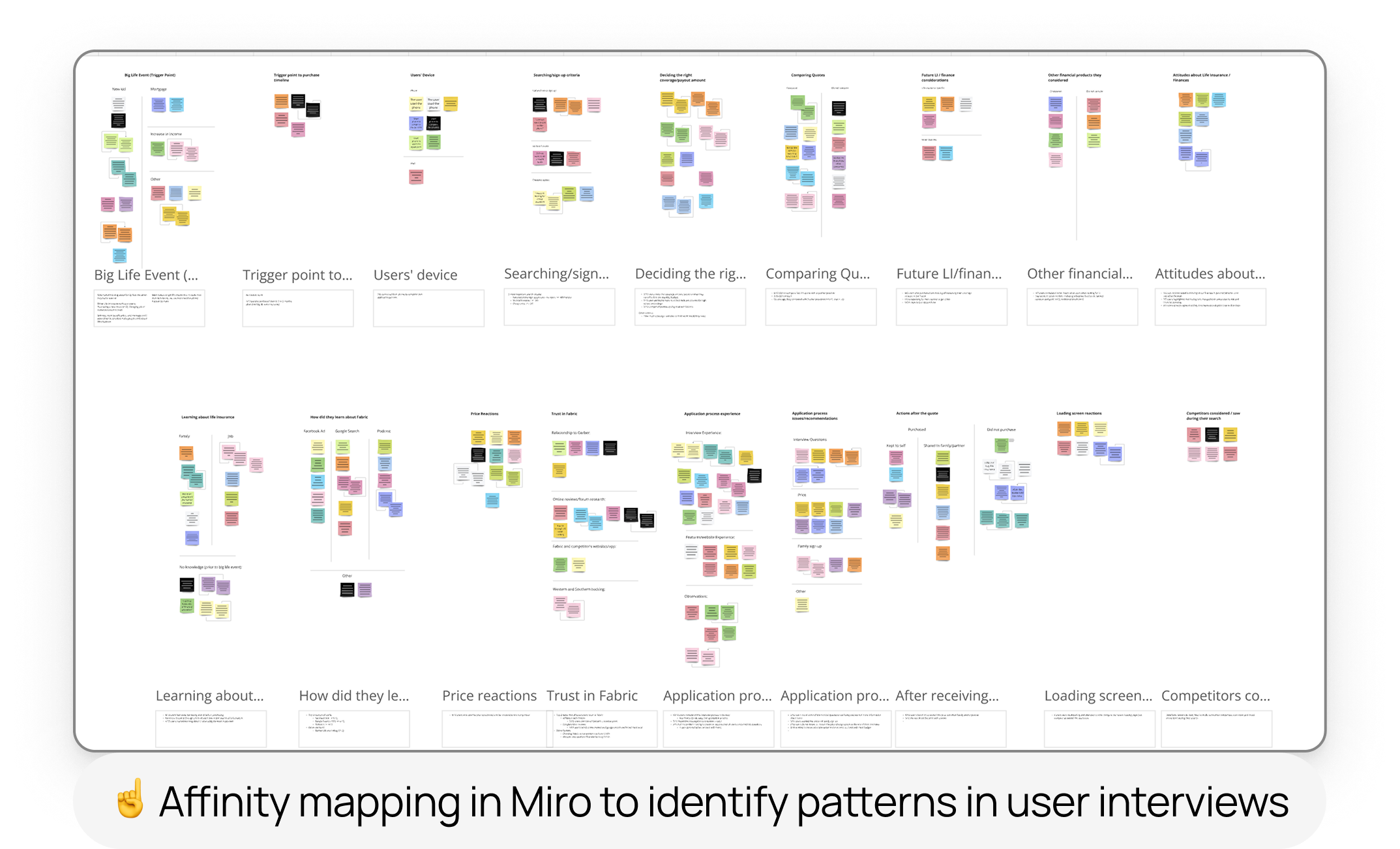
We transcribed quotes from the interviews onto Miro stickies and used affinity mapping to organize quotes from each user into categories.

As the mapping progressed, three main factors emerged:

  1. Convenience
  2. Price
  3. Readiness to buy
Affinity Mapping
Archetypes Icon

Archetypes

Meet the archetypes

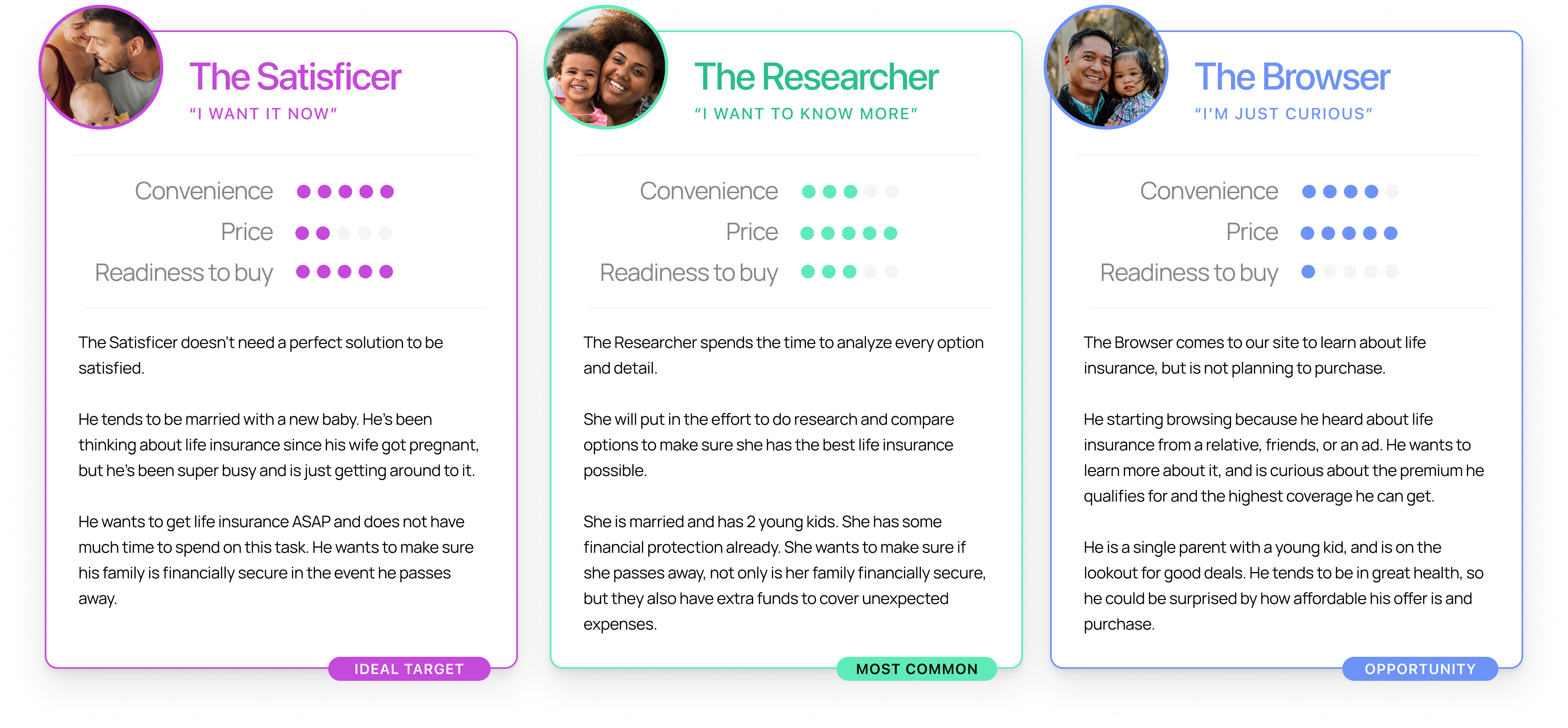
The data showed us that there were 3 main types of life insurance users:

  1. Satisficers: Users who are willing to accept the first option that meets their needs.
  2. Researchers: Users who conduct extensive research before making a decision.
  3. Browsers: Users who are not actively looking to purchase but are open to exploring options.


User Archetypes
Validation Icon

Validation

In-funnel testing

Now that we had our archetypes, we had to validate our data and see if it held up in-funnel.

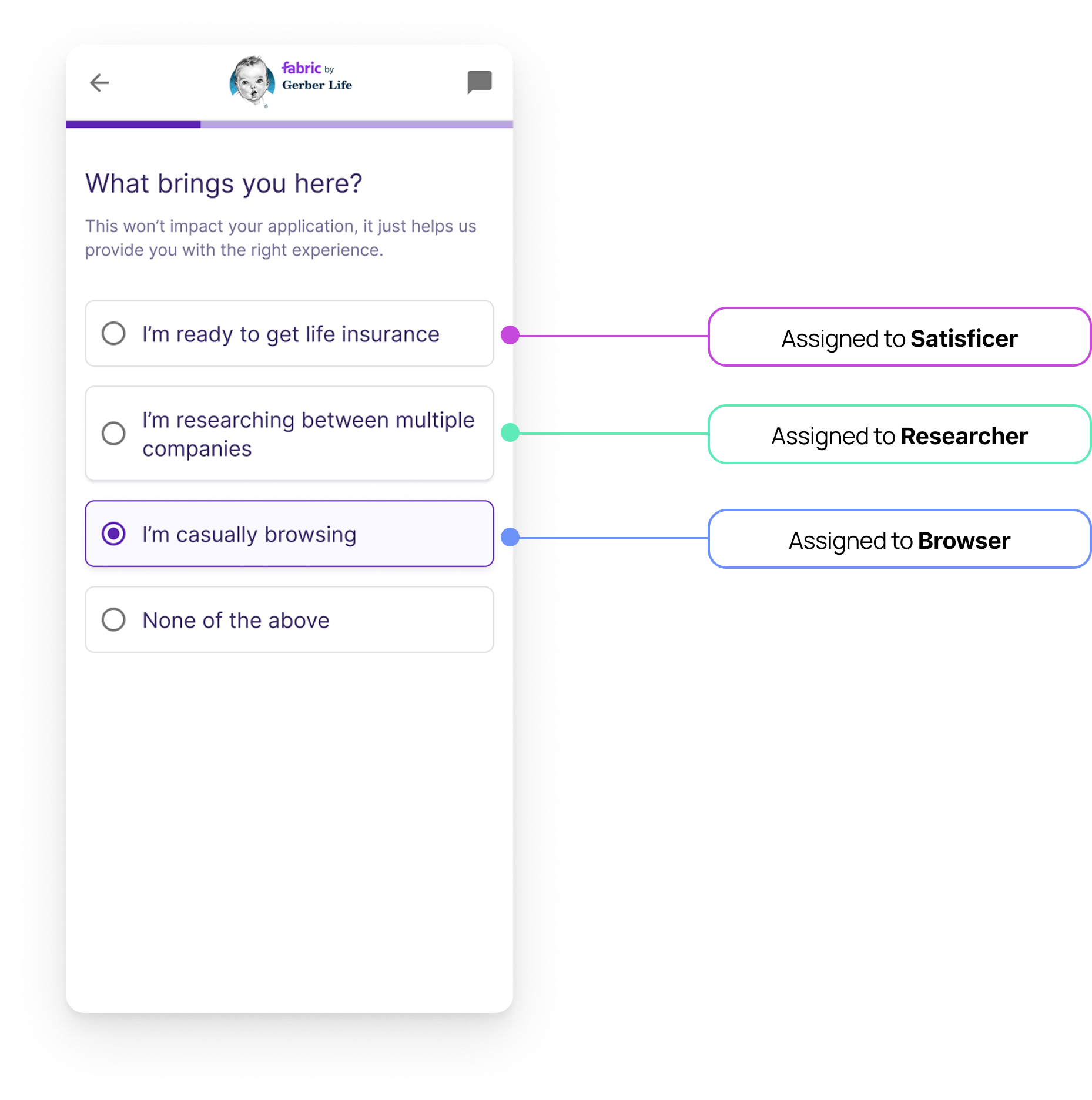
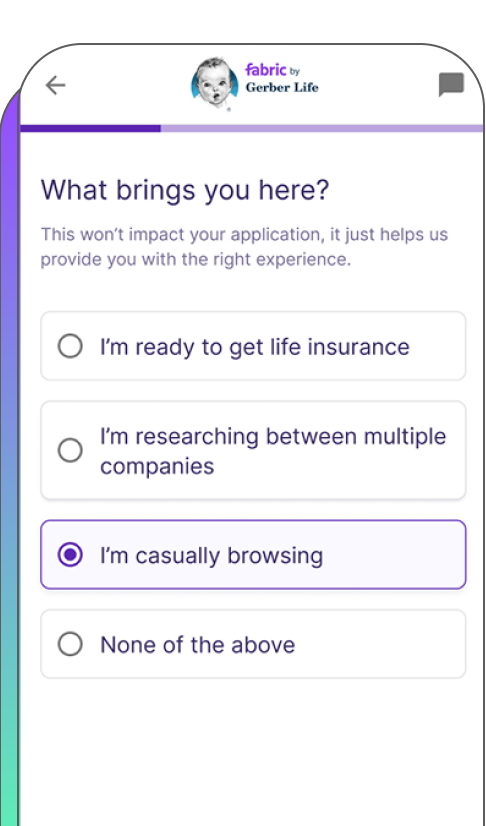
Our “user self-select” question would surface at the top of the funnel—based on the user’s selection, they would be assigned a persona ID, which would be used to track their behavior in the funnel and see if it matched our expected behavior.


User self select question

Depending on what selection the user made, we could track their behavior in the funnel and see if it aligned with what we expected, based on their archetypes. For example, if a user selected "Satisficer," we would expect them to complete the funnel quickly and with minimal interaction, while a "Researcher" would likely spend more time in the funnel, exploring options and reading more content.

RESULT: User behavior did indeed line up with the in-funnel results! We now had us the ability to run targeted tests by persona, optimizing our funnel for their specific needs.


Implementation Icon

Implementation

Archetypes now form a core part of the company strategy, unlocking the ability for more targeted funnel personalization across the entire company. I was able to prove out the impact of a dedicated UX research resource and obtained budget for a full-time contractor role.


Impact on product

Initiative: Ran a purchase page A/B test targeting price sensitivity. We found that Browsers & Researchers converted better with price sensitive designs, while Satisficers had a negative correlation.
Result: 📈 Once we served this experience to Browsers & Researchers only, we saw a +12% increase in purchase rate.

Impact on operations

Initiative: Life insurance application reviews often have long wait times. With archetypes, the Ops team was able to prioritize Satisficers, who had the highest likelihood of purchase.
Result: 📈 Led to an +8% increase in life insurance purchase rate.

Impact on marketing

Initiative: Archetype-based emails allow for more targeted messaging based on the information gathered around each persona’s goals and pain points.
Result: 📈 Led to a +43% increase in funnel conversion v. control, and a +6x increase in purchases.

Previous Arrow
Previous
Next
Next Arrow